Trenton TEP extended profile evaporators
TEP is Trenton Refrigeration's extended profile unit cooler line for walk-in coolers and freezers. Seven application classes span high temperature (25 F and up, 7 FPI), medium temperature (10 to 35 F), low temperature (-40 to 0 F) in 6 and 4 FPI, and three CO2 classes, with six defrost types and four voltages: 208-230 V and 460 V, single and three phase.
Search TEP models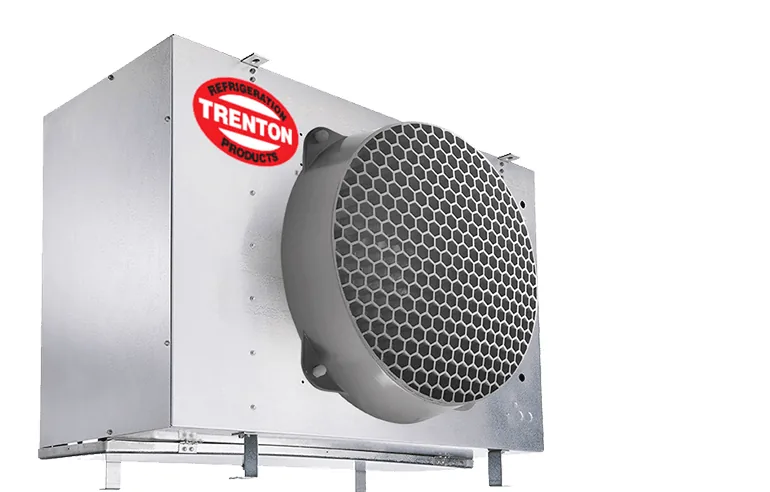
Image: Trenton Refrigeration
Nomenclature
Family
Extended profile evaporator
Nominal capacity x 1000
22 to 135 MBH (x 1000 BTU/h)
Temperature class
- MMedium temp (10°F - 35°F), 6 FPI
- LLow temp (-40°F - 0°F), 6 FPI
- VLow temp (-40°F - 0°F), 4 FPI
- HHigh temp (25°F +), 7FPI*
Generation
- EA2L and A1 refrigerant†
Voltage
- S2208-230/1/60
- S4460/1/60
- T3208-230/3/60
- T4460/3/60
Defrost
- AAir defrost
- EElectric defrost
- T3 pipe hot gas w/ electric heater pan
- H3 pipe hot gas w/ hot gas loop pan
- GReverse cycle w/ electric heater pan
- RReverse cycle w/ hot gas loop pan
† marks an option the other bulletin lists differently or not at all. * marks one this bulletin prints in its tables but leaves out of its legend.
The number after TEP is the nominal capacity in thousands of BTU/h. Unlike the other Trenton lines, it carries no fan-count digit.
Documentation history (2025 to 2026)
Generations D and E
The generation D and E bulletin (September 2025) prints both generations' data, defines D as A1 refrigerant AWEF compliant and E as A2L refrigerant AWEF compliant, and carries the CO2 classes, on which the 3 pipe hot gas defrost options are not available. The generation E bulletin (August 2026) is E only: it defines E as A2L and A1 refrigerant, adds an A2L refrigerant detection system and a positive slope hinged drain pan, and lists no CO2 class. Its legend names the medium and low temperature classes only, while its tables also print the high temperature class.
TEP models
400 documented configurations, 22 to 135 MBH (x 1000 BTU/h).
Search TEP modelsBy capacity
Rated at 10 F TD on R-448A, the maker's leading condition.
By temperature class
Sources
- [1]
- [2]
Updated